Everyone says risk off. Almost nobody says what they measured.
Risk on and risk off is the most used phrase in macro commentary and the least often derived. WatchTower runs two regime models and keeps them apart: one reads cross-asset proxies, one reads price alone. Both show their inputs, and when they disagree that is worth more than either reading on its own.
Two models
Different questions, different ways of being wrong.
Risk regime
- Asks
- Is capital moving toward risk or away from it?
- Built from
- Cross-asset proxies: the assets that lead when appetite turns, read together rather than one at a time.
- Where it fails
- It can lag a turn that starts in one asset class and has not spread yet.
Market regime
- Asks
- What is price actually doing?
- Built from
- Price action alone: trend, range, and how violently the board is moving.
- Where it fails
- It cannot see why, so a quiet market and a paused one look the same.
Neither is a refinement of the other, which is why they are two panels rather than one blended number. A blend would hide the only moment they are genuinely useful: when they point opposite ways.
Depth
A needle, or the signals behind it.
Being straight about it
The geopolitical monitor does not predict anything.
It tracks situations that are already active, what they involve, and which currencies and commodities sit closest to them. It does not forecast escalation, it does not score likelihood, and it will not tell you what happens next. Anything claiming to do that with a war or a sanctions regime is selling something.
What it is for is the connection most traders make too slowly: a situation develops, and the question is which of the markets on your board it actually touches.
The panels
Six boards.
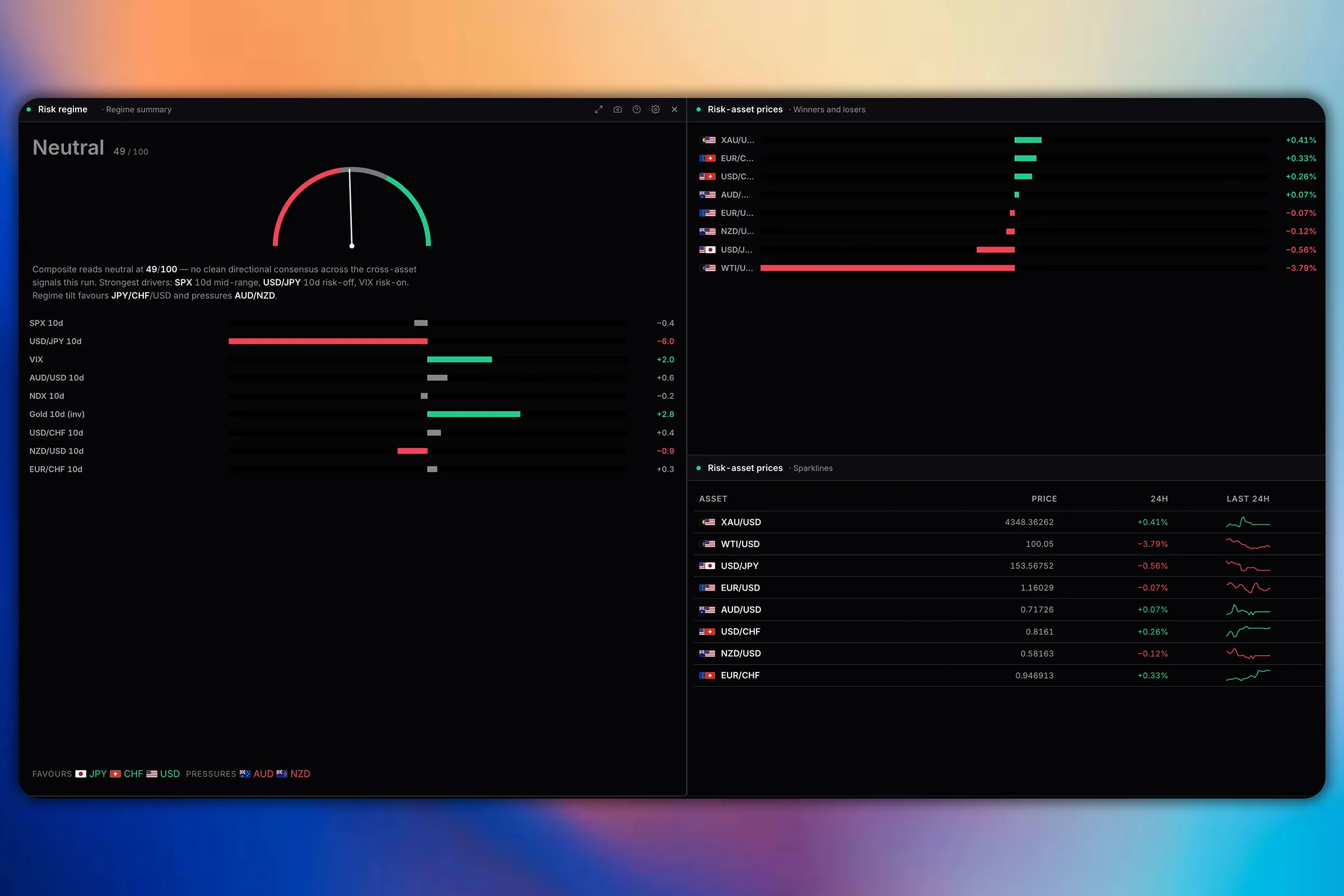
- Risk regime. The composite gauge with every signal underneath it: what each proxy is saying and which way it points.
- Risk-asset prices. Live prices for the assets used as proxies, with the day change, so the gauge can be checked against its own inputs.
- Market regime. Where the board sits read purely from price: trending, ranging, or moving hard enough that the distinction stops mattering.
- Geopolitical monitor. Active situations on a map, what each one touches, and which currencies sit closest to it.
- Currency themes. The macro themes and geopolitical risks tagged to one currency, so a theme is attached to something tradeable.
- Daily need-to-know. The lead macro headline and the paragraph behind it, for the mornings when there is time for one thing.
Risk regime, answered.
What does risk on and risk off actually mean?
Whether capital is moving toward assets that pay more when things go well, or toward the ones that hold up when they do not. It is a description of flow rather than a forecast, and it matters in FX because some currencies are bought in one environment and sold in the other regardless of their own data.
How is the risk regime measured here?
From a set of cross-asset proxies read together rather than one at a time. Every signal is shown with its own direction, so the composite can be taken apart and disagreed with. A gauge whose inputs are hidden is an assertion with a needle on it.
Why is there a separate market regime model?
Because they answer different questions and can be wrong in different ways. Risk regime asks where capital is going and can lag a turn that has not spread yet. Market regime asks only what price is doing and cannot see why, so a quiet market and a paused one look identical to it. Keeping them apart means their disagreement is visible, and that disagreement is usually the interesting part.
Does the geopolitical monitor predict escalation?
No. It tracks situations that are already active, what they involve, and which currencies and commodities sit closest to them. It does not forecast what happens next, and anything claiming to would be selling you something.
Which currencies are most affected by risk sentiment?
Historically the ones with the strongest tendencies are the funding currencies on one side and the higher-beta commodity currencies on the other, but the terminal shows the current reading rather than relying on the historical tendency, because those relationships loosen and tighten over time.
Is it free?
The free plan carries 32 of the 103 panels across 2 boards, and which ones is listed on the pricing page. Everything else is on Pro at $49 a month.