A pair is two economies. Scoring it as one instrument loses the reason it is moving.
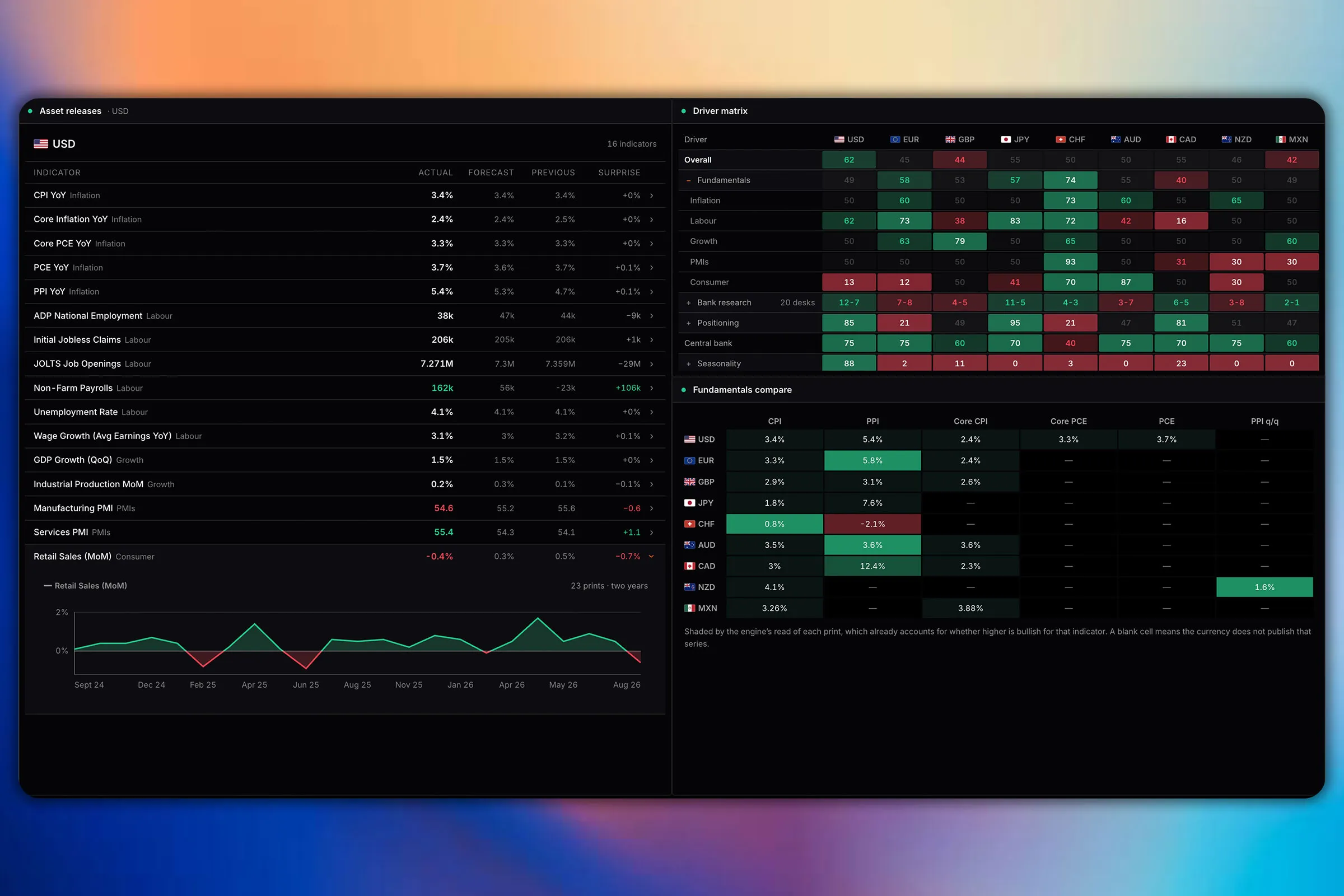
Every currency carries its own composite, built from its data, its central bank, what the desks are writing and how it is positioned. A pair is the distance between two of them, which is why WatchTower can say whether a pair is bid because the base is strong or because the quote is falling apart. Those two do not end the same way.
Two levels
A pair in mind, or asking the board which pair.
You have a pair in mind
Take it apart from both sides. A pair that is bid because the base is strong is a different trade from one that is bid because the quote is falling apart, and they do not end the same way.
- Pair focus
- Currency compare
- Pair calendar
- Pair score history
You are asking which pair
Rank the whole board by the distance between the two sides, so the widest gaps surface rather than being hunted for.
- Trade scanner
- Pair scanner
- Top divergences
- Top 5 pairs
- Currency pair heatmap
- Momentum basket
Depth
A number on the pair, or a reading of both sides.
Being straight about it
What a divergence is and is not.
A divergence is a pair where one side scores strongly and the other weakly, so both currencies point the same way. It is a place to look, ranked by how wide the gap is. It is not an entry, a stop or a size, and the terminal does not offer those. A wide gap can stay wide for weeks, and a pair can be perfectly divergent while the market trades something else entirely, which is what the sensitivity read is for.
The panels
Ten boards.
- Pair focus. The full breakdown for one pair: the composite, both currencies underneath it, and what each side contributes.
- Currency compare. Two currencies set directly against each other, driver by driver, which is how a pair actually gets read.
- Currency pair heatmap. The full pair matrix across the majors, so the strong and weak corners of the board are visible at once.
- Pair calendar. The economic calendar filtered to one pair, covering both currencies rather than one.
- Pair score history. The composite pair score over time, derived from both sides rather than from the price.
- Trade scanner. Every tradable read the engine holds in one ranked table.
- Pair scanner. All pairs meeting a minimum divergence threshold, live.
- Top divergences. The cleanest two-sided setups: strong base against weak quote, ranked by the size of the gap.
- Top 5 pairs. The five pairs with the largest directional edge on the board right now.
- Momentum basket. The whole board ranked by how far it has moved over a week, which is a different question from where it should be.
Every pair
The board, ranked by the gap between the two sides.
Each pair opens into its own page: both composites, both central banks, both positioning readings and what the desks are publishing on each leg. A gap narrower than 11 points sits inside the model's neutral band, and those pages say so rather than manufacturing a view.
- USD/CAD 25 to USD
- USD/JPY 19 to USD
- AUD/USD 18 to USD
- USD/CHF 17 to USD
- EUR/USD 16 to USD
- GBP/CAD 15 to GBP
- NZD/CAD 14 to NZD
- NZD/USD 11 to USD
- GBP/USD 10 to USD
- EUR/CAD 9 to EUR
- GBP/JPY 9 to GBP
- GBP/AUD 8 to GBP
- NZD/JPY 8 to NZD
- CAD/CHF 8 to CHF
- GBP/CHF 7 to GBP
- AUD/NZD 7 to NZD
- AUD/CAD 7 to AUD
- EUR/GBP 6 to GBP
- CAD/JPY 6 to JPY
- NZD/CHF 6 to NZD
- EUR/NZD 5 to NZD
- EUR/JPY 3 to EUR
- EUR/AUD 2 to EUR
- CHF/JPY 2 to CHF
- EUR/CHF 1 to EUR
- GBP/NZD 1 to GBP
- AUD/JPY 1 to AUD
- AUD/CHF 1 to CHF
Composites as of 1 October 2026. The live readings are in the terminal.
Pair analysis, answered.
How is a currency pair scored?
From both currencies, not from the pair. Each currency carries its own composite built from its fundamentals, its central bank, what the desks are writing, seasonality and positioning. The pair reading is the distance between those two composites, which is why it can say which side is doing the work.
Why does it matter which side is driving?
Because the two do not end the same way. A pair rising because the base currency is genuinely strong tends to keep going while that strength holds. A pair rising because the quote currency is falling apart can reverse the moment that stops, without the base ever having been strong. A single number on the pair cannot tell those apart.
What is a divergence?
A pair where one side scores strongly and the other scores weakly, so both currencies point the same way for the trade. Those are ranked by the size of the gap rather than presented as a list, because a wide gap and a narrow one are not the same idea.
Does the scanner give trade signals?
It ranks pairs by the distance between the two composites and shows what produced each reading. It does not size a position, set a stop, or say when to enter. Nothing here is financial advice.
Which pairs are covered?
Crosses between the 9 scored currencies, so majors and crosses alike rather than majors only.
Is it free?
The free plan carries 32 of the 103 panels across 2 boards, and which ones is listed on the pricing page. Everything else is on Pro at $49 a month.