A strength meter says a currency went up. It cannot say whether anything is underneath it.
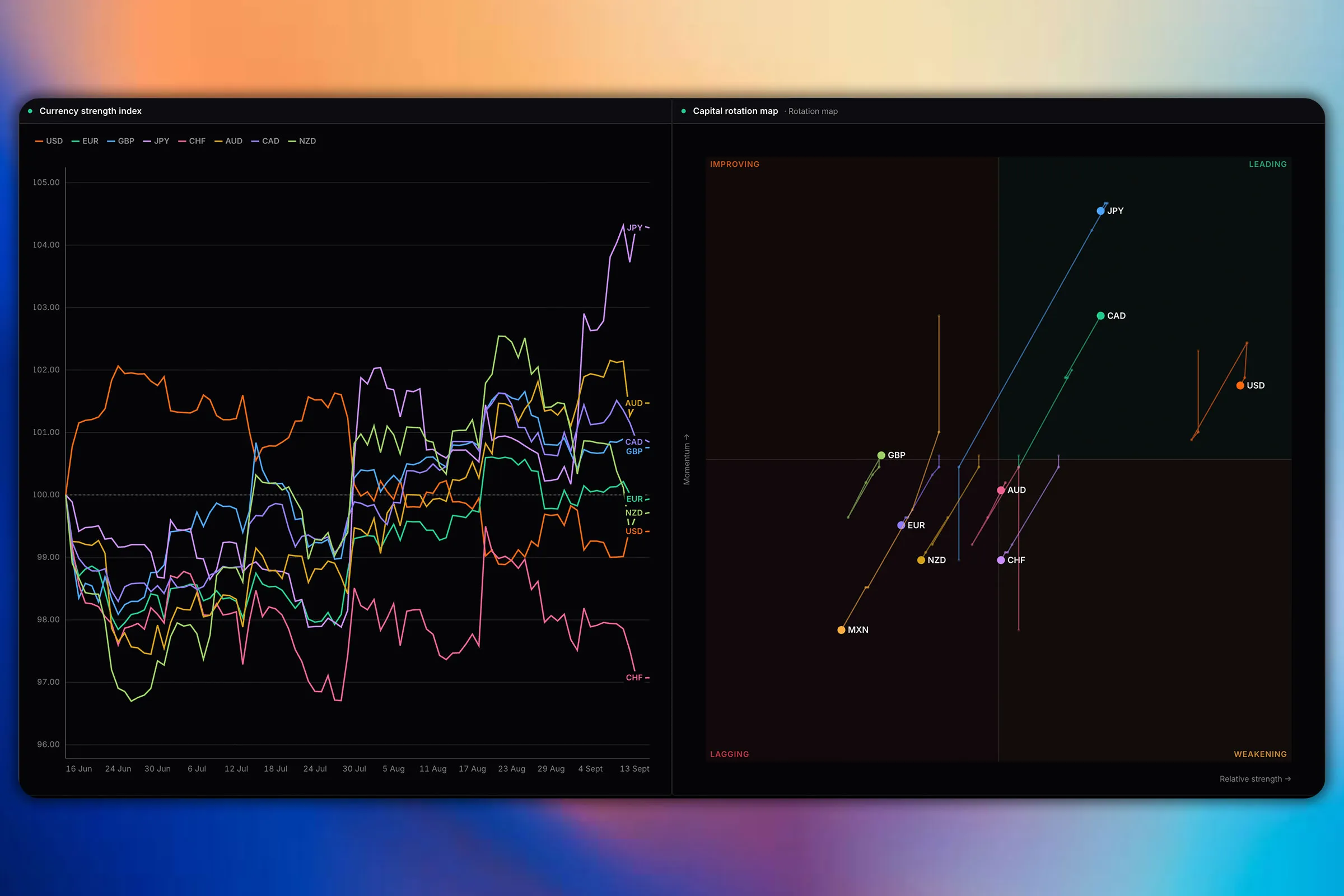
Strength measured from price is useful and circular at the same time: the currency is strong because it rose, which is what you were looking at when you asked. WatchTower carries that reading and a second one built from the drivers underneath, and the interesting case is when the two disagree.
Two readings
What each one answers, and what it is blind to.
Strength from price
- Built from
- Movement across every pair a currency appears in, indexed over the window you choose.
- Answers
- What has actually happened. Which currencies are being bought and sold, right now and over the week.
- Blind to
- It is circular by construction: a currency is strong because it went up. It cannot say whether anything is underneath the move, so a squeeze and a repricing look identical.
Strength from drivers
- Built from
- The composite score: data against consensus, the central bank, what the desks are writing, seasonality and positioning.
- Answers
- Whether the case for a currency is improving or deteriorating, independently of what price has done this week.
- Blind to
- It is not a forecast. A currency can score well for a month while the market trades something else entirely, and nothing here promises price will come round to it.
Neither replaces the other. A price meter with nothing underneath it and a driver score that price is ignoring are two different kinds of incomplete.
Depth
Eight bars, or eight bars and the reason.
Being straight about it
A disagreement is information, not a signal.
When a currency scores well on its drivers and badly on price, that says the market is not trading its fundamentals at the moment. It does not say price will come round, and nothing on this page claims it will. Currencies go months being driven by flow, positioning or risk appetite while their own data sits ignored.
What the disagreement is good for is knowing which fight you are in. A trade built on the driver case while price disagrees is a trade against the current flow, and that is worth knowing before the position is on rather than after.
The panels
Eight boards.
- Currency strength index. Relative strength over time, indexed to 100 at the start of the window, so the shape of the move is visible rather than a single bar.
- Live currency strength. Which currencies are being bought and sold right now, built from live prices across the board.
- Currency anatomy. The other reading: one currency taken apart into its scored drivers, with what each contributed.
- Driver matrix. Every driver against every currency at once, so a currency strong for one reason and one strong for six are visibly different.
- Live movers. The biggest gainers and losers across the assets you select, ranked and refreshed.
- Volatility ranking. Realised volatility and average daily range, because a strong currency in a violent week is a different proposition from a strong one in a quiet week.
- Asset statistics. The statistical profile of any asset: historical volatility and return percentiles.
- Price correlation matrix. Rolling correlation of daily returns, which is how you find out that two currencies you thought were separate bets are one.
Currency strength, answered.
How does a currency strength meter work?
The usual kind takes every pair a currency appears in and combines the moves into one figure, so eight currencies become eight bars. It is a compact way to see what has been bought and sold, and it is genuinely useful for that.
What is wrong with strength measured from price?
Nothing, as long as its limit is understood. It is circular by construction: it says a currency is strong because it went up, which is the thing you were already looking at. It cannot distinguish a squeeze from a repricing, and it has nothing to say about whether the move has support underneath it.
What is the second reading?
The composite score, built from the data against consensus, the central bank, what the research desks are writing, seasonality and positioning. It asks whether the case for a currency is improving, independently of what price did this week.
What does it mean when the two disagree?
That the market is not currently trading the fundamentals of that currency, which happens often and for long stretches. It is information rather than a signal: it does not mean price will come round, and nothing here claims it will. It does mean a trade built on the driver case is fighting the current flow, which is worth knowing before rather than after.
Which currencies are covered?
All 9: 24 markets in total once metals, energy and indices are included.
Is it free?
The free plan carries 32 of the 103 panels across 2 boards, and which ones is listed on the pricing page. Everything else is on Pro at $49 a month.