A false headline costs more than a slow one.
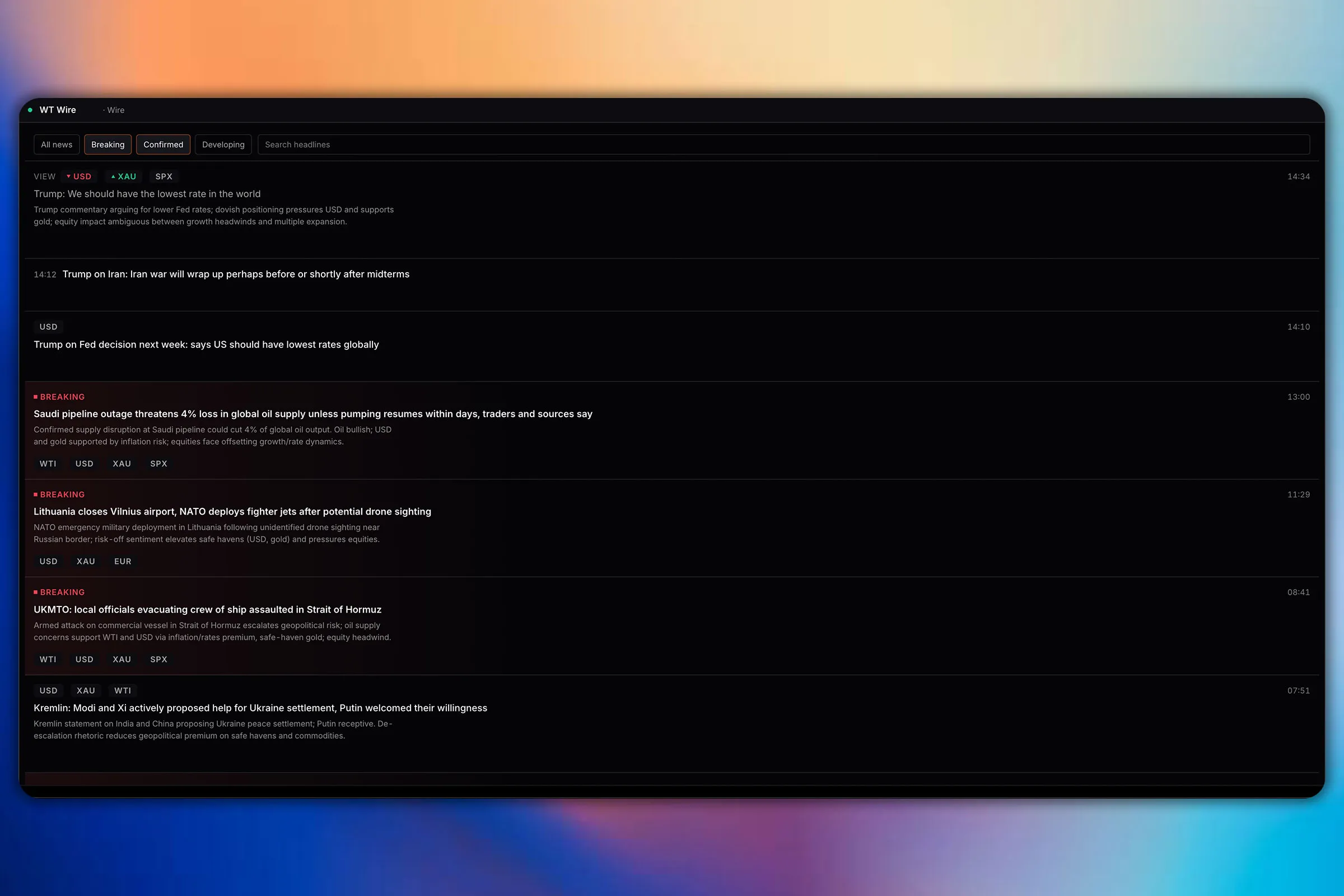
A wrong headline is not a neutral event. It moves the market, then unwinds when it is corrected, and anyone who traded it is caught on both legs. WT Wire cross-checks fast-wire headlines against other sources before they reach the terminal. That is deliberately slower than a raw feed, and the trade is on the page rather than in the small print.
The trade-off
Both choices cost something.
A raw fast wire
- What you get
- The headline the instant it exists. If you are trading the first ten seconds of a print, nothing else will do, and this is not that.
- What it costs
- Every false or misquoted headline arrives at the same speed as the true ones, and it is on your screen before anyone knows which it was.
A corroborated wire
- What you get
- A headline that has been seen in more than one place before it reaches you, so what arrives is far more likely to still be true in an hour.
- What it costs
- Time. Waiting for a second source is slower than not waiting, always, and a story that only one outlet has will not appear until somebody else has it too.
If being first in the ten seconds after a release is the edge, a raw wire is the right tool and this is not it. That is worth saying plainly rather than discovering after paying.
Depth
Speed, or confidence.
The panels
Seven boards.
- WT Wire. The corroborated feed: fast-wire headlines cross-checked across sources before they are published to the terminal.
- Trending headlines. Stories drawing outsized coverage right now, ranked by how far they have spread rather than by when they arrived.
- Daily report. The macro daily brief in full, written for the session rather than assembled from the day headlines.
- Daily need-to-know. The short version: the lead story and the paragraph behind it, for mornings when there is time for one thing.
- Weekly brief. The editorial for the week: the theme it is built around and what would change it.
- Analyst videos. The daily video desk with the written summary and the takeaways beside it, so it can be read rather than watched when there is no time.
- Squawk chat. Live channel discussion in the terminal, so a reaction does not require a second window.
The newswire, answered.
What does corroborated mean here?
A headline is not published to the terminal on the strength of one source. It is cross-checked against others first, and what reaches you has been seen in more than one place. The method is the point rather than the supplier list, which is why the sources are not named.
Does that make it slower?
Yes, and there is no way around it. Waiting for a second source is slower than not waiting. If your edge is being first in the ten seconds after a release, a raw wire is the right tool and this is not it. This is for the trader who would rather not act on a headline that unwinds an hour later.
Why does a false headline matter so much?
Because it is not a neutral event. A wrong headline moves the market, then unwinds when it is corrected, so anyone who acted on it is caught on both legs. The cost of one of those is usually larger than the benefit of being thirty seconds early on the true ones.
What does trending measure?
How far a story has spread across coverage, not how recent it is. A headline that has been picked up everywhere in twenty minutes is telling you something different from one that arrived twenty minutes ago and has been ignored.
Is the daily report written or generated?
It is produced by the terminal from what it is reading across the desks, the data and the wire, and it is written as a read rather than as a list of headlines. The weekly brief is built around a theme and states what would change it.
What is free?
The free plan carries 32 of the 103 panels across 2 boards, and which ones is listed on the pricing page. Everything else is on Pro at $49 a month.