Every market has a seasonal pattern. The useful question is how often it held.
With twelve months and a few decades of history, something will always look striking. What separates a tendency worth a small nudge from a coincidence is the sample underneath it, so WatchTower draws the path, projects it forward, and shows how consistent it has actually been. It carries 13.5% of a currency composite, and no more than that on purpose.
Being straight about it
What a seasonal tendency is worth.
It is a prior, not a prediction. It shifts the odds a little before you look at anything else, and it is worth close to nothing against a live central bank repricing or a data surprise. A market that usually rises in October will fall in October the year the Fed turns, and the pattern will still be there in the average afterwards.
That is the whole reason it is weighted at 13.5% here rather than presented as a strategy. This section is before the panels rather than after them because a seasonality tool that puts its caveats at the bottom is selling the chart.
Three steps
The third is the one most tools skip.
The path
What a market has typically done through the year, averaged across its recorded history and drawn as a percentage path rather than a table of monthly averages.
The projection
That path extended forward over the window you choose, so the tendency is placed against where price actually is rather than left as a shape on its own.
The reliability
How consistent the pattern has been: how many years it held, how wide the spread around the average is, and therefore how much weight it deserves. This is the step most seasonality tools skip, and it is the one that decides whether the first two mean anything.
Depth
An average, or an average with its sample attached.
The panels
Five boards.
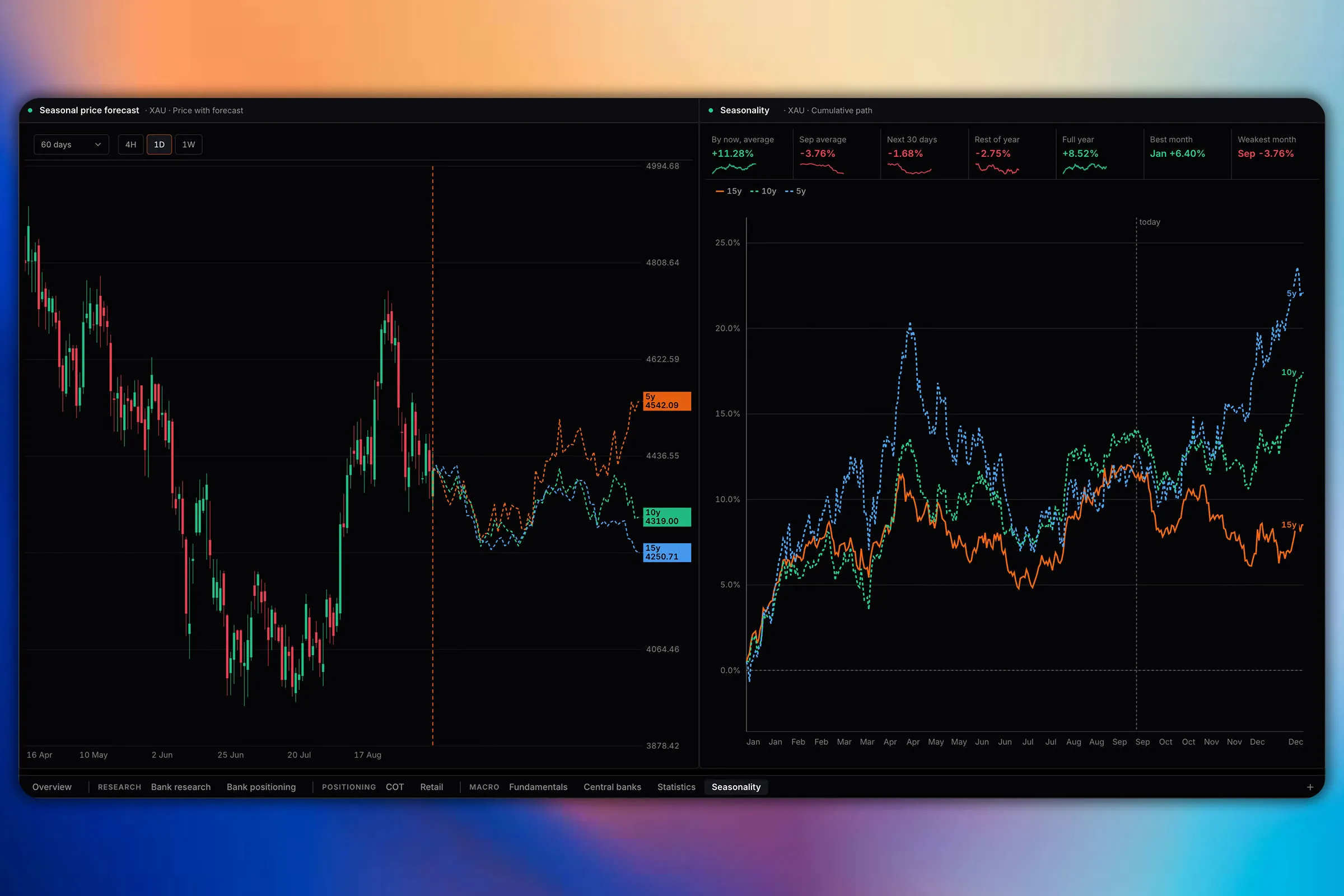
- Seasonality. The historical seasonal path for any market: currency, metal, energy contract or index, drawn as a percentage path through the year.
- Seasonal price forecast. The seasonal path projected ahead over your chosen window, set against the current price.
- Asset statistics. The statistical profile behind the pattern: historical volatility and return percentiles, which is the context that says whether a seasonal move is large or ordinary for that market.
- Asset score history. The composite through time, so the seasonal component can be seen in the context of everything else that was scoring at once.
- Currency anatomy. One currency taken apart, including what seasonality contributed at its 13.5% weight.
Seasonality, answered.
What is FX seasonality?
The tendency of a market to move in a particular direction at a particular time of year, measured across its recorded history. It comes from real things, fiscal year ends, commodity cycles, repatriation flows and holiday liquidity, but the effect is a tendency across many years rather than a rule about any one of them.
Does seasonality actually work?
Sometimes, weakly, and not reliably enough to trade on its own. The honest description is that it is a prior: it shifts the odds slightly before you look at anything else, and it is worth almost nothing against a live central bank repricing or a data surprise. That is why it sits at 13.5% of the composite here rather than at the front of it.
How do you know a pattern is not just noise?
You often cannot be certain, and the tool shows you what it has rather than deciding for you: how many years the pattern held, and how wide the spread around the average is. A tendency that held in nine years out of ten with a tight spread is a different object from one driven by two extreme years, and they look identical if all you print is the average.
How far back does the history go?
As far as the recorded history for that market allows, which varies by asset. The panel shows the sample it is working from rather than implying a uniform depth across everything.
Which markets have seasonal data?
All 24 scored markets: currencies, metals and energy, and equity indices.
Is it free?
The free plan carries 32 of the 103 panels across 2 boards, and which ones is listed on the pricing page. Everything else is on Pro at $49 a month.