Getting Started
What Moves Currency Prices? A Beginner's Guide
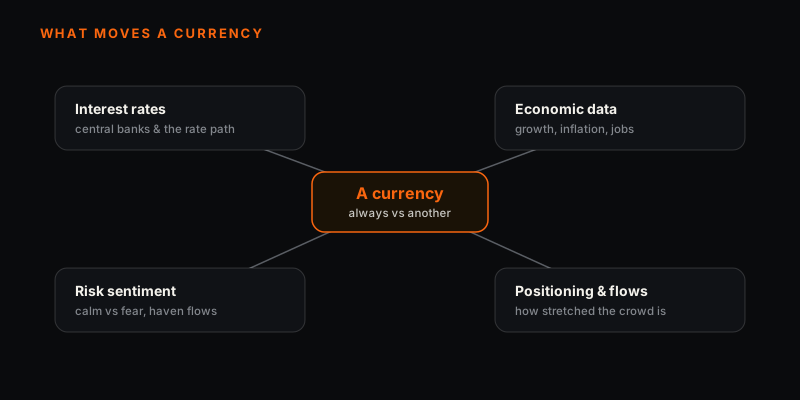
Currencies move on a handful of big forces: interest rates, economic data, risk sentiment and positioning. Here is a plain-language guide to each, and how they fit together.
If you are new to trading currencies, the first useful question is the simplest one: what actually makes a currency go up or down? The good news is that most of the movement comes from a short list of forces. Once you know what they are, the market stops looking random. This is a plain-language guide to each, with a link to a deeper read where you want one.
First, a currency is always relative
Before the forces, one idea that trips up almost every beginner. A currency never moves on its own. It always moves against another currency, as a pair. When you read that the euro is up, it is up against something, usually the dollar. So every driver below is really about one currency relative to another. A pair moves on the difference between the two sides, not on one side alone.
1. Interest rates and central banks
This is the big one. Money is drawn to where it is paid more, so the level of interest rates, and crucially the direction they are expected to move, is one of the strongest forces in currencies. When a central bank is expected to raise rates faster than another, its currency tends to strengthen, often well before the move happens, because markets price the future. The full mechanism is in rate differentials explained, and how central banks signal their intentions is in how to read a central bank meeting.
2. Economic data
Growth, inflation and employment data matter because they shape what central banks will do next. A run of strong data pushes expectations toward higher rates and tends to support the currency; weak data does the reverse. You do not trade the data for its own sake so much as for what it does to the rate path.
3. Risk sentiment
Some days the market is calm and willing to take risk, and some days it is fearful. That mood decides a lot, because in a fearful, risk-off market, capital rushes to safe-haven currencies like the dollar, the yen and the Swiss franc, regardless of their own fundamentals. Understanding this mood is often the difference between a move that makes sense and one that looks baffling, and it is covered in risk-on, risk-off.
4. Positioning and flows
Markets are moved by people taking positions, and when too many have already crowded onto the same side, the fuel to push further runs low and the trade becomes vulnerable to a sharp reversal. Reading how stretched the crowd is comes from the COT report and retail sentiment.
The dollar sits on one side of most trades
Because the US dollar is on one side of most currency pairs, understanding what moves the dollar specifically takes you a long way. That deserves its own read, in what moves the US dollar.
How they fit together
Here is the part that separates a beginner from someone who reads the market well. These forces do not act one at a time. They interact, and sometimes they conflict. A currency with every rate advantage can still fall in a risk-off panic. A strong data run can do nothing if the market already expected it. The skill is reading the forces together and noticing when they agree and when they fight, which is the approach in how corroboration works.
WatchTower Terminal was built to put these forces side by side for each currency, so instead of gathering them from a dozen places, you can read rates, data, risk and positioning in one view. That is the fastest way to go from “currencies look random” to seeing what is actually driving them.
Reading this is one thing. Seeing it live is another.
The composite score on 24 markets, positioning across 44, and the research consensus behind them. 2 boards free, no card.