Positioning
Retail Sentiment vs COT: The Two Crowds
Retail traders and institutions are two different crowds, and they are often on opposite sides. Here is how to read retail sentiment, and why the divergence is the signal.
There are two crowds worth watching in any market. There are the large speculators, the funds whose positions show up in the COT report, and there is the retail crowd, the individual traders whose collective positioning is captured through broker sentiment data. They are two different groups, they often sit on opposite sides, and the gap between them is one of the more useful things you can read. This piece is the companion to my guide on reading the COT report, looking at the other crowd.
Two crowds, two behaviours
The large speculators in the COT report are mostly trend-followers with real capital and research behind them. They tend to build into moves and hold. I covered how to read them, and their crowded extremes, in the COT piece.
The retail crowd behaves differently. Retail sentiment data, drawn from what individual traders are doing at their brokers, tends to show a group that leans against trends. Retail traders often sell into strength and buy into weakness, trying to catch tops and bottoms. That behaviour gives retail sentiment a well-known character, which is that it frequently works as a contrarian signal.
Why retail sentiment is read as a contrarian tool
The common framing is that the retail crowd is net wrong at the extremes, and there is a structural reason for it rather than anything about intelligence. Retail traders tend to be under-capitalised relative to the size of the moves they trade, quick to take small profits and slow to cut losses, and inclined to fade strong trends because a move looks overextended. Put together, that means when retail is heavily net long, it often reflects a crowd leaning against an up-move that then continues, and heavy retail longs can be a bearish tell, with heavy retail shorts the reverse.
The key word is extremes. When retail sentiment is roughly balanced, it says very little. When it is stretched heavily to one side, the contrarian read becomes worth paying attention to.
The signal is in the divergence
Here is where the two crowds come together, and where I find the most value.
When the retail crowd and the large speculators sit on opposite sides, that divergence is a strong signal. Picture retail heavily net long a currency while the funds in the COT data are net short. That is the informed, trend-following money and the contrarian retail money pointing in opposite directions, and history tends to favour the funds’ side in that standoff. The divergence sharpens the read that either crowd would give alone.
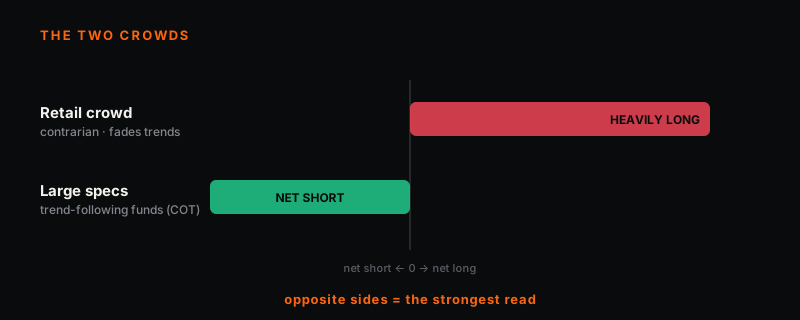
When both crowds agree, sitting on the same side, the edge is weaker and I treat it as less informative. It is the disagreement between the two that carries the most information, which is the same principle that runs through everything I do.
The traps
A few cautions keep this honest.
Retail sentiment is broker-specific. Any single feed is a sample of one broker’s clients, not the whole retail world, so treat it as a directional read rather than a precise measurement.
The contrarian logic is not a timing tool. Retail can be net long and wrong for a long time before the move resolves, in exactly the way a crowded COT extreme can persist. Stretched sentiment flags a condition, never a moment.
And the idea that retail is always wrong is an oversimplification. Retail can be right, especially in strong trends where fading is punished but following is not. The contrarian edge lives at the extremes, not in a blanket rule that the crowd is stupid.
How I use it
I read retail sentiment as a contrarian layer and the COT data as the positioning layer, and I care most when they disagree. Retail stretched one way against funds stretched the other is the configuration that earns my attention. When they line up, I lean on other evidence.
As with everything, neither crowd is a signal on its own. Retail sentiment against my thesis at an extreme is a warning. Retail sentiment stretched against the funds, and lined up with a macro case I already believe, is corroboration, which is the approach I laid out in how corroboration works.
In WatchTower Terminal I keep retail positioning next to the COT data and the macro score for each asset, so the two crowds sit side by side and the divergence between them is immediately visible.
The retail crowd and the institutional crowd are both telling you something. The trick is to watch them together, and to pay the closest attention on the days they disagree.
Reading this is one thing. Seeing it live is another.
The composite score on 24 markets, positioning across 44, and the research consensus behind them. 2 boards free, no card.