48 desks, one screen, and whether each one was right.
Bank research arrives as PDFs written for somebody else, one desk at a time, with no way to set one against another. WatchTower reads what the desks publish and turns it into fields you can rank: the call, the level, the conviction, the thesis, and how it ended.
The desks
Named, so you can check them against what you trade.
Coverage varies by asset and by week, because a desk publishes when it has something to say. These are among the 48 whose published views are read:
- ING
- MUFG
- UniCredit
- Westpac
- Danske Bank
- Crédit Agricole CIB
- SEB
- Scotiabank
- Nordea
- Rabobank
- Berenberg
- Commerzbank
- CIBC
- Natixis
- Lloyds Bank
- Wells Fargo
- Société Générale
- ANZ
What a call carries
Five fields, and the last one is the point.
- Direction
- Long, short or neutral, on a named asset rather than a paragraph that implies one.
- Level
- Entry, target and stop where the desk published them, blank where it did not. A call with no level is still a call and is kept as one.
- Conviction
- How strongly the desk stated it, so a house view and a passing remark are not weighted the same.
- Thesis
- The reasoning in the desk own terms, not a summary that drops the condition the whole call rested on.
- Outcome
- Whether it reached its target, was stopped, expired unfilled, or is still open. This is the field that makes the rest worth reading.
Depth
A library, or a comparison.
The panels
Six panels.
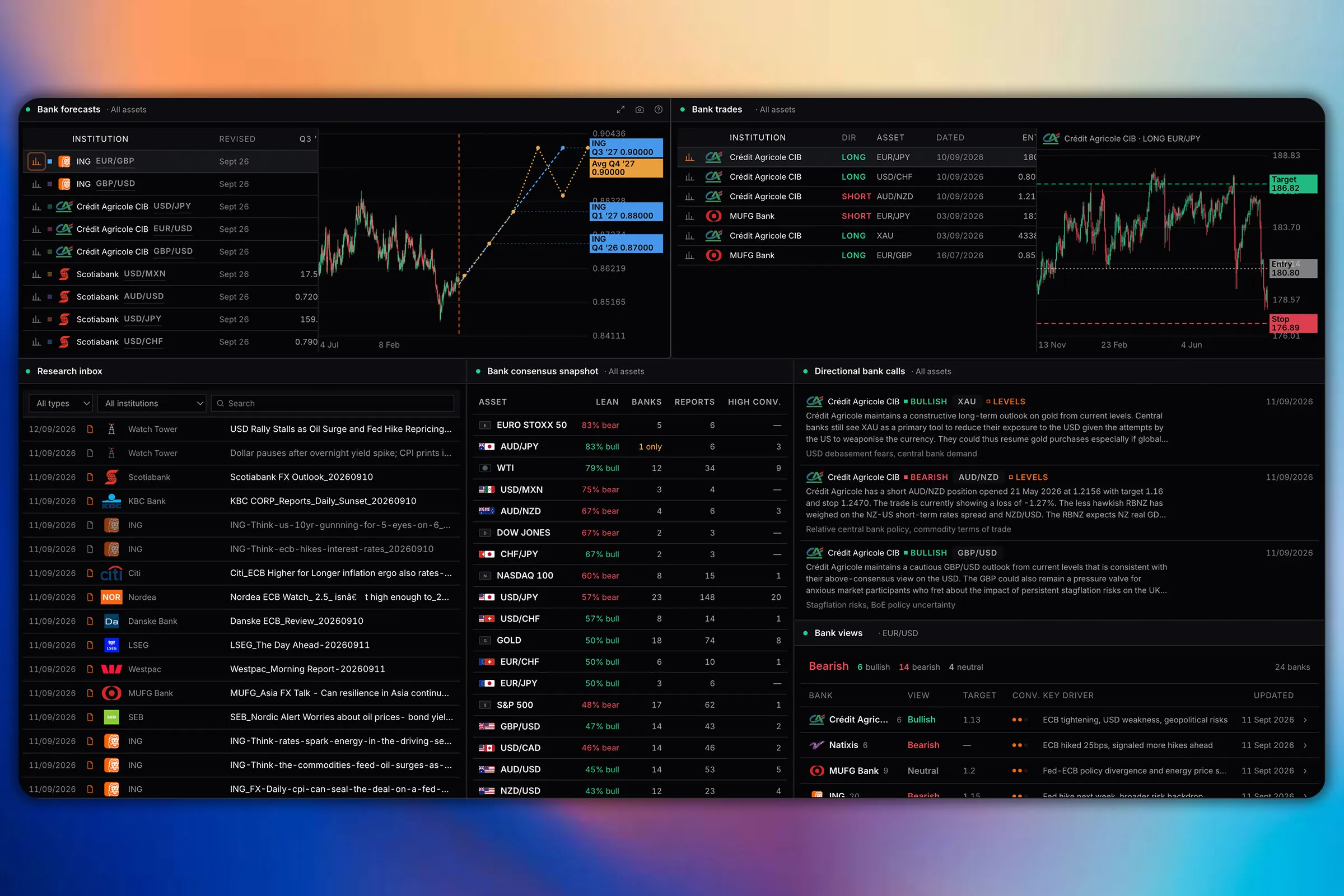
- Bank calls. Where the desks stand on each asset: how the reports split bullish against bearish, how many desks are behind that, and the calls themselves inside the row, including the ones with no levels attached, which are the ones most tools drop.
- Bank research. What the desks are publishing: the stream as it lands, filtered by asset, currency, desk, theme, sentiment or conviction; one asset with a row per desk and everything it said before kept underneath; or one asset written up with its drivers and how sentiment has moved.
- Bank trades. Every setup the desks have published: direction, entry, target and stop, the reward for the risk, whether price has reached the entry, and how it ended once it closes.
- Bank forecasts. Where the banks expect an asset to trade, quarter by quarter: each bank's target against today's price, their average and the move it implies, drawn forward on the chart.
- Data forecasts. What each desk expects an upcoming release to print, with the median and the spread between them: who is behind the consensus number and how far apart they are.
- Research inbox. Every piece of research in one stream, newest first, so nothing arrives without being seen. Open a bank report and break it down into its argument, its subjects and its calls.
Bank research, answered.
Whose research is covered?
48 institutions. The desks include ING, MUFG, UniCredit, Westpac, Danske Bank, Crédit Agricole CIB, SEB, Scotiabank and others. Coverage varies by asset and by week, because desks publish when they have something to say rather than on a schedule.
Does this give me the bank PDFs?
No, and it is worth being clear about that. This is not a report library and it does not redistribute research. It reads what desks publish and turns it into something comparable: the call, the level, the conviction, the thesis and the outcome, per asset, across every desk at once.
What happens to a call that has no entry or target?
It is kept as a directional call with the level fields blank. Most tools drop these, which quietly biases the consensus toward desks that happen to publish levels. A view without a number is still a view.
Can I see whether a desk was right?
For the setups, yes. In Bank trades every closed setup shows how it ended: target reached, stopped, or expired unfilled, and the open ones show whether price has reached the entry yet. Without that field a research feed is just opinion with a logo on it.
Does bank research feed the score?
Yes. Institutional sentiment is one of the components of the composite score for each asset. The full weights are published on the method page rather than described.
What does it cost?
The bank research panels are Bank research, Bank calls, Bank trades, Bank forecasts, Data forecasts and Research inbox, and bank research is also one of the drivers behind every score in Asset scores. The terminal is $10 for your first month, then $49 a month, or $490 a year with 2 months free. Cancel from Billing at any time.